

Parental Rights in Arizona

How We Can Help With Your
Parental Rights in Arizona
A typical day in our office includes calls from fathers who are being denied access to their child. We understand how difficult and frustrating it is for fathers to have their child kept from them. This is especially true when it seems like the other parent is doing it for no good reason—or simply out of spite.
You are not alone in this situation. We have helped many parents like you gain access to their child. We have helped many of these parents go from no Parenting TimeThis is what it sounds like—this is when it’s the parent’s time with the child(ren). See A.R.S § 25-401(5). Prior to 2012, it was known as physical custody.Read more about Parenting Time to equal parenting time, and in some instances, we have assisted fathers who went from no Parenting TimeThis is what it sounds like—this is when it’s the parent’s time with the child(ren). See A.R.S § 25-401(5). Prior to 2012, it was known as physical custody.Read more about Parenting Time to full custody. We can help you get your rights to your child and to be the parent you want to be for your child.
Simplified 10-Step Process
Establishment of Paternity in Arizona
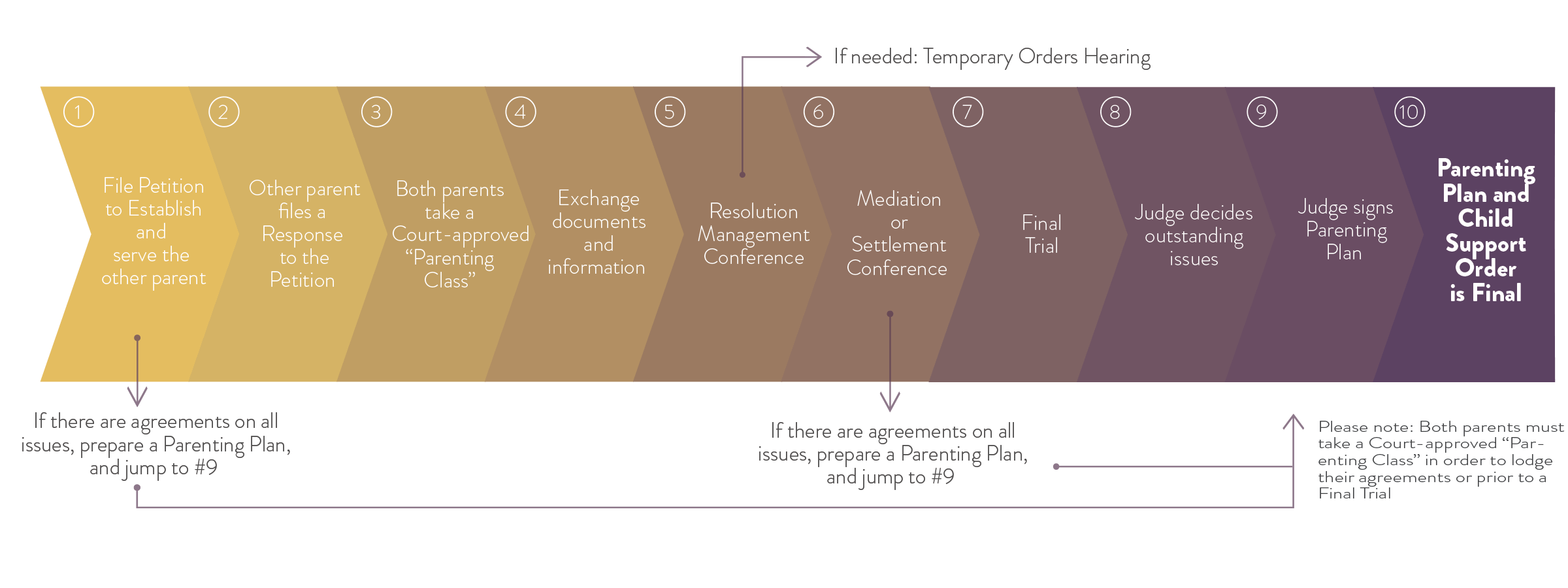
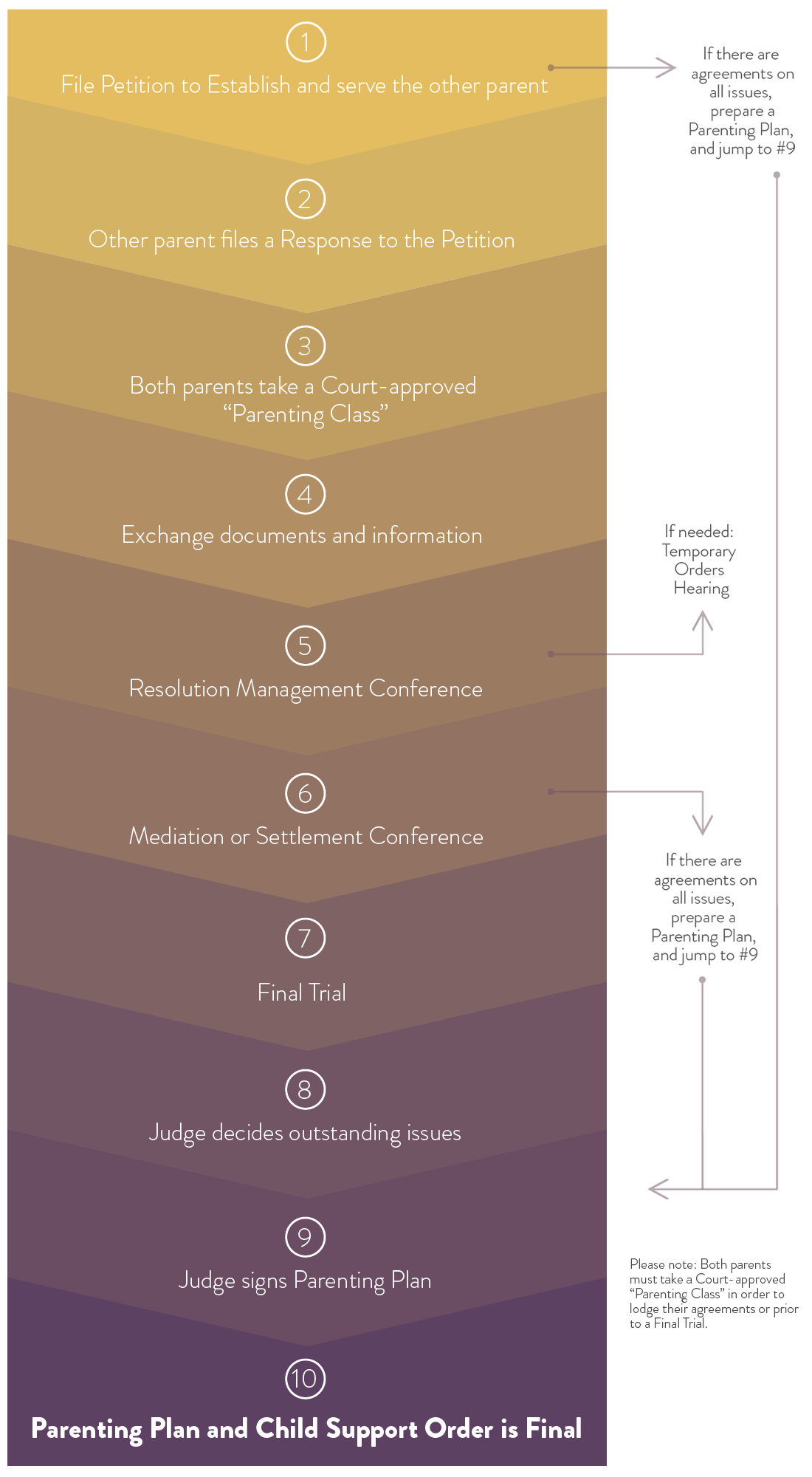
What you need to know
Parental Rights
1. Deciding whether to file
Studies show that the children do better when they have both parents in their lives, yet it is not unusual to see a mother trying to cut a father out of their child’s life. For unmarried fathers in such a situation, their hand is forced—they need to file with the Court to establish their rights. In most cases, the child will be better off because they did so,
In other cases, even when the father is being permitted to see the child, filing to establish rights may still be necessary to ensure that he is the “Legal ParentA person who is the biological or adoptive parent of the child and whose rights have been established and not terminated. See A.R.S. § 25-401(4). For biological mothers, such rights are established at birth. Fathers, though, must establish their rights to be a legal parent. See…Read more about Legal Parent” of the child and protects his rights to the children.
Questions to Consider:
- What happens if you don’t file? Will you be allowed to see the child? If you are seeing the child now, but something happens to the mother, what would happen with the children?
- What kind of Parenting PlanThis is the Court order that contains the legal decision-making and parenting time orders. It sets forth the parenting time schedule and includes the other custody orders.Read more about Parenting Plan would you want to seek? What plan would be best for your child?
- What concerns do you have about Mother?
- What concerns about you as a parent is Mother likely going to raise? Do you have any history of drugs, criminal activity, alcoholism, or violence? If so, what can you do to show the Court that those things are behind you? If it’s an ongoing problem, is this something where you’d be better off getting help, getting better, and then filing?
- Is your home ready for a child to live in it?
2. Establishing Your Rights
As an unmarried father, until you “establish”, your rights don’t exist. There are four components to what must be established, and you need to establish all four in order to make your rights equal to Mother’s:
- Paternity. You are not legally your child’s parent until you’ve established paternity. Even being listed on the birth certificate does not necessarily mean you are considered to be a legal parent. Under Arizona law, being on the birth certificate only gives you a PresumptionA legal standard where the person who holds the presumption has the advantage in a case. When a presumption is established, the burden is on the other party to produce enough evidence to overcome the presumption. See also Rebuttable Presumption.Read more about Presumption that you are your child’s father. You still need to go get a court order to officially become your child’s Legal ParentA person who is the biological or adoptive parent of the child and whose rights have been established and not terminated. See A.R.S. § 25-401(4). For biological mothers, such rights are established at birth. Fathers, though, must establish their rights to be a legal parent. See…Read more about Legal Parent.
- Parenting Time. Parenting time refers to the schedule when the child is with each parent. Prior to the Court ordering parenting time, parenting time is technically decided by the mother.
- Legal Decision-MakingThis is the right to make decisions on behalf of the child when it comes to decisions involving the child’s health, education, religion, or personal care. It does not include the right to dictate the child’s parenting time schedule or place conditions on the other parent’s time.…Read more about Legal Decision-Making. Legal decision-making is the right to make decisions on behalf of your child when it comes to their healthcare, education, religious, and personal choices. Prior to the Court issuing a Legal Decision-MakingThis is the right to make decisions on behalf of the child when it comes to decisions involving the child’s health, education, religion, or personal care. It does not include the right to dictate the child’s parenting time schedule or place conditions on the other parent’s time.…Read more about Legal Decision-Making order, this right belongs to Mother.
- Child SupportBy law, every person has a duty to support their biological or adopted children. See A.R.S § 25-501(A). This applies without or without a court order. The term “child support,” though, generally refers the Court-ordered amount one parent is required to pay to the other parent.Read more about Child Support. Parents have a legal duty to support their children, and while a child support amount cannot be ordered until Child SupportBy law, every person has a duty to support their biological or adopted children. See A.R.S § 25-501(A). This applies without or without a court order. The term “child support,” though, generally refers the Court-ordered amount one parent is required to pay to the other parent.Read more about Child Support is established, you could be ordered to pay back child support. Additionally, child support must be decided whenever parenting time is addressed.
3. The Court Process to Establish
While Arizona’s laws allow a mother to be in control before a dad establishes his rights, it’s a different story once you’re in Court and a judge is deciding what will happen. With your rights being established, no more gender preferences exist. Judges are to decide what to order based strictly on the best interests of the child. Under Arizona law, judges are to presume a child’s best interests are for each parent to share in legal decision-making and have as much parenting time as possible. Therefore, unless someone presents enough evidence to convince the judge that another arrangement is more appropriate, a judge will typically order Joint legal decision-makingIf the court orders joint legal decision-making, the parties must agree on all decisions related to the child’s health, education, religious upbringing, or personal care.Read more about Joint legal decision-making and equal parenting time. Of course, if the judge is convinced there are safety concerns, logistical issues, or some other reasons why 50-50 would not be in the child’s best interests, the judge can order a different plan.
Filing the Petition to EstablishA document that starts a case involving unmarried parents where the Court will be making a decision for the first time. This typically includes first-time orders for paternity, legal decision-making, parenting time, and child support.Read more about Petition to Establish. The Petition to Establish is the paperwork that starts the Court process. It contains several documents in addition to the Petition to EstablishA document that starts a case involving unmarried parents where the Court will be making a decision for the first time. This typically includes first-time orders for paternity, legal decision-making, parenting time, and child support.Read more about Petition to Establish, including a SummonsA Court document notifying someone that a case has been filed against them and directing them that they must either file a Response or appear at a hearing on a certain date. A summons is one of the documents that must be served on a party either through a process server…Read more about Summons and, if a Father is on the birth certificate, a Preliminary InjunctionThis is a court order that goes into effect, by law, whenever a Petition for Dissolution (Divorce) is filed or for certain custody matters. See A.R.S. § 25-315 and A.R.S. § 25-808. It prevents the parties from doing certain things, including removing children out of state. The…Read more about Preliminary Injunction.
Service. You will need to serve the mother with your PetitionThis is a court document that someone files to start a case.Read more about Petition. You can serve her in one of three ways: (1) via Process ServerThis is someone certified by the superior court to provide paperwork of a court proceeding to a person who is entitled to receive such notice. When a process server completes service, they will file an Affidavit of Service with the courts.Read more about Process Server, (2) via certified mail, return receipt, delivery restricted to the mother, or (3) giving her the paperwork and having her sign an Acceptance of Service in front of a notary. Merely handing her the papers is not service. Proof that service was made needs to be filed with the Court.
Response. The mother will have twenty (20) days to file a Response if she was served in Arizona. If outside of Arizona, she has thirty (30) days. If she does not file a Response, you can move for DefaultWhen a party does not file an Answer, the other party can file an Application and Motion for Default and request all the items they listed in their Petition. The Motion for Default must be provided to the opposing party, and they are given ten (10) more days to respond. After…Read more about Default.
Temporary OrdersOrders the court puts in place while the parties go through discovery and disclosure on the case. The orders are in place until further order of the Court. Common temporary orders are orders for legal decision-making, parenting time, spousal maintenance, child support, exclusive…Read more about Temporary Orders? You have the option of filing for temporary orders. Temporary OrdersOrders the court puts in place while the parties go through discovery and disclosure on the case. The orders are in place until further order of the Court. Common temporary orders are orders for legal decision-making, parenting time, spousal maintenance, child support, exclusive…Read more about Temporary Orders are somewhat common in Father’s rights cases because the mothers often are not letting the father see the child. A temporary order is the quickest option to get a court order in place. It can still take two months to get temporary orders in place—but that’s about as swiftly as the court system can move. Temporary orders are also expensive because they require a TrialA court hearing in which evidence and testimony are taken, and the Court makes a final determination of the issues raised in a petition. Trials and evidentiary hearings are somewhat synonymous, but the difference is one of scope: Evidentiary hearings are more limited in scope…Read more about Trial, and even though they shouldn’t, they also have a direct impact on the final disposition of the case. So, before filing for temporary orders, it is important to consider whether it is the right move for you.
DisclosureFollowing Rule 49, this is when you provide documents, evidence, and information regarding your case to the other side. Any evidence you want to use must be disclosed to the other side. Disclosure is not filed with the court.Read more about Disclosure, DiscoveryGoverned by Rules 51 to 65 of the Arizona Rules of Family Law Procedure, this is the formal process of acquiring information that you need to put on your case. This includes options like interrogatories (written questions), depositions, subpoenas, and Requests for Productions.…Read more about Discovery, and Evaluations. Disclosure is the process in which you must disclose to the mother any documents or other evidence you wish to use in court. Rule 49The family law rule for disclosure of documents and witnesses. This rule must be followed; otherwise, the opposing party may object to evidence presented at trial on the basis on non-disclosure. See ARFLP Rule 49.Read more about Rule 49 of the Family Law Rules of Procedure require you to disclose certain items to the mother. Discovery describes the different court processes of obtaining information from the mother or a third PartyAn individual, entity, or the state that either brings the lawsuit or is required to respond to the lawsuit. See ARFLP Rule 3(f).Read more about Party. In many contested custody cases, the Court will appoint a neutral third party to conduct interviews and examine evidence and make recommendations to the Court.
4. Settlement Discussions
Judges often give a speech to parents about the importance of the parents themselves deciding what happens with a child. Parents are in a better position to know what is best for their child than a judge is. Because a judge typically has 700-800 cases going at any one time, the judge will probably only spend a few hours on your case. For that reason, judges encourage parents to try and settle. The judge may order you to attend MediationA common settlement method where the parties use a mediator, a neutral third party, to negotiate a settlement. Family law mediations usually involve the mediator meeting separately with each party and their attorneys. Mediation is often highly effective.Read more about Mediation or exchange SettlementAn agreement by parties in a lawsuit to resolve the case without going to trial. This can be resolving all the issues or just a few of the issues. The issues resolved should be reduced into a written agreement that both parties sign and then submit to the Court for approval. This…Read more about Settlement letters.
If an agreement can be reached, the two of you will prepare and file a Parenting Plan and Child Support OrderThe order signed by the judge for child support, which besides providing the amount of child support paid each month, directs how child support should be paid, how unreimbursed medical expenses will be divided, and which parent can claim the child on taxes each tax year. The…Read more about Child Support Order for the judge to sign.
5. Trial
If you cannot reach an agreement, you will need to go to trial. Trials require substantial work. You must make sure all your exhibits and witnesses have been disclosed to the other side by the applicable deadlines. You have to prepare the exhibits and deliver them to the Court by the deadline (usually a week ahead of TrialA court hearing in which evidence and testimony are taken, and the Court makes a final determination of the issues raised in a petition. Trials and evidentiary hearings are somewhat synonymous, but the difference is one of scope: Evidentiary hearings are more limited in scope…Read more about Trial) and deliver them in accordance with the instructions in the Minute EntryThese are documents issued by the Court as part of the official court record. A Minute Entry can serve many purposes including ruling on motions or trials, summarizing the record from a hearing, setting forth orders of the court, clarifying a prior ruling, appointing an expert to…Read more about Minute Entry setting trial. You have to prepare your Pretrial Statement, which is the most important document you’ll file in a case. You have to prepare what you’re going to present, choose whether you’ll have anyone else testify, determine your Cross-examinationWhen a witness is questioned on the stand, under oath, by the party who did not call the witness. Cross-examination almost always follows a direct-examination.Read more about Cross-examination strategy, and then you have to put on the trial itself and be ready to make objections to mother’s evidence and handle objections mother may have for your evidence.
My child’s mom won’t let me see my child. What can I do?
We get this call from a father at least once a day. We can certainly help you figure out what you need to do. Generally speaking, when a mother won’t let you see the child, it is time to go to Court. You do that by filing a Petition to Establish Paternity, Legal Decision-making, Parenting Time, and Child Support with the Court. When you are not able to see the child, you may also want to consider filing for temporary orders, which is usually your quickest option to having a Parenting PlanThis is the Court order that contains the legal decision-making and parenting time orders. It sets forth the parenting time schedule and includes the other custody orders.Read more about Parenting Plan put in place. But we recommend you speak with an attorney before deciding what filing is best for your situation.
I live in Arizona, but child lives in another state. Nothing has ever been filed in Court. Can I file in Arizona to get custody?
It depends. For Arizona to have JurisdictionThe authority of a Court to hear and decide a certain issue. Each court’s ability to hear cases are defined either by a Constitutional provision, or, more commonly, by an Act of Congress (for Federal courts) or the state legislature (for state courts).Read more about Jurisdiction over custody, it has to be the home state of the child. That means Arizona has to be the state where the child most recently resided for six consecutive months. If Arizona is not that state, then Arizona cannot make a custody order, and you will need to file in the state where your child has most recently resided for six consecutive months.
If the Court orders equal parenting time, will I have to pay child support?
Possibly. Child support must be ordered unless the parties agree to a DeviationWhen the Court orders a child support or spousal maintenance amount different than what is on the Child Support Worksheet and the Spousal Maintenance Calculator. While Courts rely heavily both on the Child Support Worksheet and the Spousal Maintenance Calculator, the Court does…Read more about Deviation, and the Court finds the deviation is in the child’s best interests. Child support is done on a formula, and when parenting time is equal, the amount (1) usually is not very much, and (2) is usually paid by the parent who earns more money. There is no gender bias in the formula that requires that it will be the father, and not the mother, who pays child support; it may be you, it may be her—it really does come down to how the formula shakes out.
The mother didn’t give the child my last name. Can I change the child’s last name?
You can petition the Court to change the child’s last name. You will have the burden of proof, and the standard you have to prove is that changing the last name is in the child’s best interests. What that means is, essentially, you had better have a good reason as to why the name change will benefit your child. The Court is not going to change the last name simply because, traditionally, children bore their father’s last names.
My baby’s mother listed another man on the birth certificate. What should I do?
You need to file a Petition to Establish Paternity ASAP. There are deadlines for challenging paternity determinations, and a delay could cost you your chance to be a parent to your child. If the deadlines have passed, it is still possible to challenge who the father is, but it becomes much more difficult.
If I have legal decision-making, can I change my child’s name?
No, the authority to change the child’s name is not included within the legal decision-making authority. You will need either a Court order or the agreement of the other parent.
I am a father, and the mother didn’t give our child my last name. Can’t I require that the child has my last name?
Not necessarily. The law does not require that the child bear the father’s last name. If you want the child to bear your last name, you will need either a Court order or the agreement of the other parent.
In Pizziconi v. Yarborough, 177 Ariz. 422 (App. 1994), the Arizona Court of AppealsThis is the Court that hears appeals and special actions from the decisions made by the superior court. A panel of three judges reviews each appeal and issues a ruling. The Arizona Supreme Court is the only state court higher than the Court of Appeals.Read more about Court of Appeals rejected the idea that a child must bear a father’s surname and adopted the reasoning from the Supreme Court of Utah that because these are now times of parental equality, it is no longer automatic that a child bears a father’s surname. Instead, the issue must be decided on in the child’s best interests.
Once the child has a name, can it be changed?
Yes, a child’s name can be changed. Any changes to the child’s name either need to be agreed upon by the parents or ordered by the Court.
What if the other parent does not agree to change the child’s name?
Then you can ask the Court to change it. You do so by filing a PetitionThis is a court document that someone files to start a case.Read more about Petition for a Name Change with the family court. You can also bring a name change as its own petition or as part of a legal decision-making or parenting time proceeding.
What is the standard the Court looks at when deciding whether to change the child’s name?
The Court must look at whether the name change is in the best interests of the child. A.R.S. § 12-601(B). To aid in that, the Arizona Court of Appeals has come up with five factors known as the Pizziconi factors. They are as follows:
- The child’s preference
- The effect a name change would have on preserving and developing the relationship with each parent
- The length of time the child has borne a given name
- The difficulties, harassment, or embarrassment that the child may experience from bearing the present or proposed name
- The motive of the parents and the possibility that the use of a different name will cause insecurity or a lack of identity
The Court must also consider certain items under A.R.S. § 12-601(C), which are aimed at ensuring the name change is not being filed for a fraudulent purpose (and, honestly, are more geared for adults who want to change their name). These elements include whether the person requesting the change has a felony background or is facing felony charges for making a false statement or false identification.
Good People.
Great Results.
Our award-winning team of professionals deliver
the outcomes our clients need.
Don't Take Our Word For It,
See What Our Clients Have To Say.

Any issue or question I have has always been answered. I am super grateful to Jillian because I feel like I have someone by my side 100% of the time.
- AJ
Throughout this entire process, everyone at the firm treated me with the courtesy and respect that you would extend a lifelong friend, and for that humble gesture I shall remain forever grateful . . .
- MV
The best at what they do! Im so impressed by the knowledge Stephen has off the top of his head. The whole crew is amazing . Would highly recommend them.
- JS
I've never met such a passionate, organized, and responsive group of attorneys. Family law matters can be emotionally and legally challenging but this group stands out as the place to go to get great help
- AA
The team that works here is professional, timely, and has your best interests at the root of every decision. They work tirelessly and have an amazing array of experience to act on your behalf..., they’d always be my choice!
- EU
Highly recommend this firm for family law disputes. The efforts that they put forth to a case are some of the best that you can get, but they also know how to really work with a client and make it feel like a team atmosphere
- AC
I know some of the lead attorneys at State 48 Law Firm, and have complete faith and trust in their knowledge and professionalism. I would trust them implicitly, with my own legal needs.
- BJ
Excellent team of attorneys. Everyone has a wealth of experience and a great depth of legal knowledge. I would highly recommend this firm to anyone.
- ML
I can't recommend State 48 Law Firm enough. They have a great team of experienced attorneys, although I highly recommend Bryce Johnson! He has a wealth of family law knowledge and will fight for you.
- LW
I've known and worked with State 48 attorney Bryce Johnson for several years and know him to be a considerate and tactful attorney who fights tooth and nail for his clients. I would recommend State 48 for your family law needs!
- ZS
Everyone at State 48 Law Firm is great! Jillian Hansen will take the time to educate you about the process while showing empathy for the situation.
- ZB
State 48 Law includes a very experienced team of lawyers who will work tirelessly for you. I would recommend their team, and specifically Bryce Johnson, to anyone.
- JK
During one of the most difficult periods in your life, it is imperative to find a lawyer and a law firm, who can look after your interests.
- KB
I’ve worked with this Team before & can’t say enough about their professionalism & constant communication. Highly recommend State48 for anything family law.
- KH
My attorney takes her time, is very responsive, and shows that she does care. You don’t usually find that compassion in a lawyer. I can’t thank her enough for helping us through our case and I highly recommended her!
- HG
Contact State 48 Law
We offer in-person, video, and phone consultations.